

How To Draw Trees With Colored Pencils
Welcome to the definitive guide to drawing trees. This page features four in-depth lessons on how to draw trees using various mediums and approaches.
Use the table of contents below to skip to the lesson of your choice or get through each lesson chronologically.
Lesson One: How to Draw a Tree with Pencil (Graphite)
In this lesson, we'll explore a structured arroyo to drawing a realistic tree with pencil. The approach that I'll share with you lot can exist practical to whatever species of tree and can fifty-fifty be adjusted to drawing bushes and shrubbery. In this approach, we'll examine specific aspects of the tree and apply what is observed to the drawing.
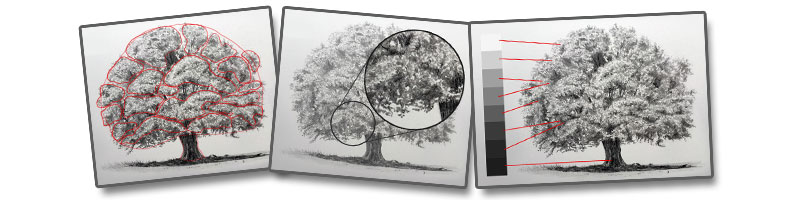
You're probable to discover the most success cartoon a tree from ascertainment, but you lot can likewise use this method to drawing a tree from your imagination.
What You'll Need...
In this example, nosotros'll draw the tree using graphite pencils. Three pencils are used, but the pencils that you may use are dependent on the force per unit area that you typically place on the pencil. Ultimately, you'll need to create a full range of value in the drawing. For this reason, a range of graphite grades are used.
- 2H Pencil - Used for establishing the shapes. (Too much pressure with this pencil could create depressions in the surface of the paper.)
- HB Pencil - Used for developing the mid tones and the lighter values.
- 4B Pencil (or equivalent) - Used for developing the darker values.
Since texture will play an important role in the drawing, the surface that yous choose to piece of work on is important. For this example, Bristol newspaper (vellum surface) is used. This newspaper is very smooth, but even so has an ample tooth (texture) to take multiple applications of graphite.
Bristol paper provides a good amount of control over the mark, but the texture in the drawing must be developed through mark-making and value alone. (Particular of texture created on Bristol paper is pictured below left.)
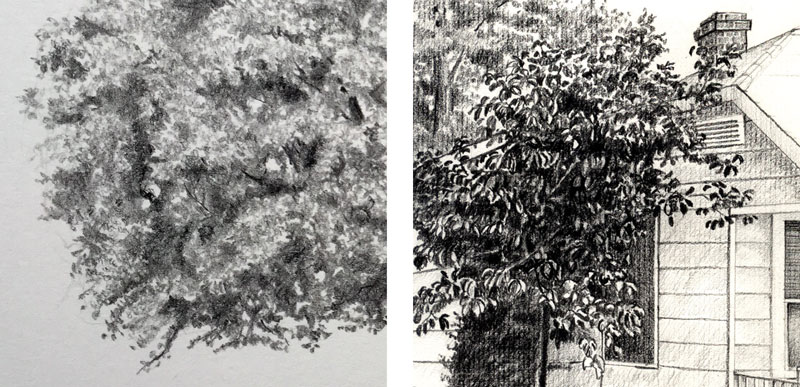
Some will prefer a paper with a greater texture. Working on a surface with a bit more than tooth tin aid in the development of the texture of the leaves. Charcoal paper is a good solution for those wanting to exploit the surface texture. (Item of texture created on charcoal newspaper is pictured higher up right.)
Keys to Drawing Trees
Information technology's like shooting fish in a barrel to become overwhelmed when yous look at a tree. There are so many details! Just to draw one accurately, nosotros demand not exist consumed with these details. Instead, we'll breakdown the tree into three simple aspects. We'll develop each aspect individually, post-obit a structured arroyo.
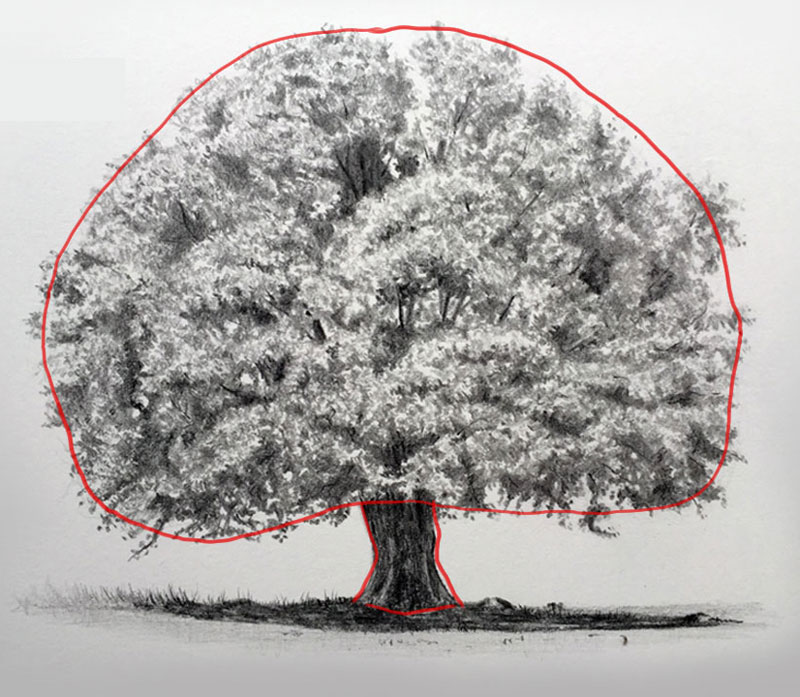
Step 1 - Observe the Shape(s) - The first matter we'll do is define the overall shape of the tree. Drawing lightly with the 2H pencil, nosotros'll concentrate just on the outer contours.
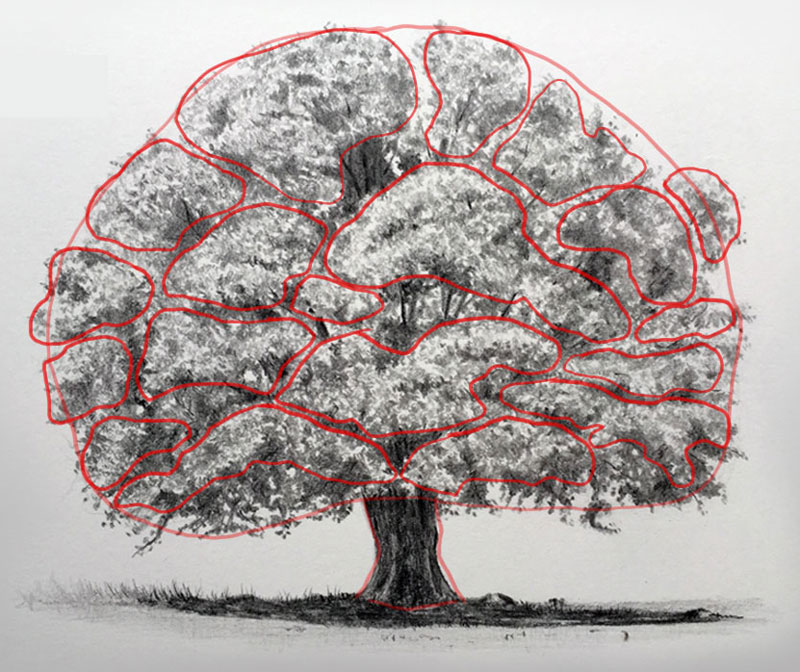
With the outer contours defined, we'll next detect the smaller shapes inside the awning of the tree. These locations are "clumps" or collections of leaves found at the cease of the branches.
Step two - Develop the Texture - Using the defined shapes as a guide, we'll starting time to develop the texture of the leaves. This process requires patience. Take your time and remain consistent. It is not necessary to draw every leaf, instead nosotros'll create the illusion of collections of leaves. We'll retrieve almost each "clump" or drove of leaves as a form, developing the highlights and shadows on each.
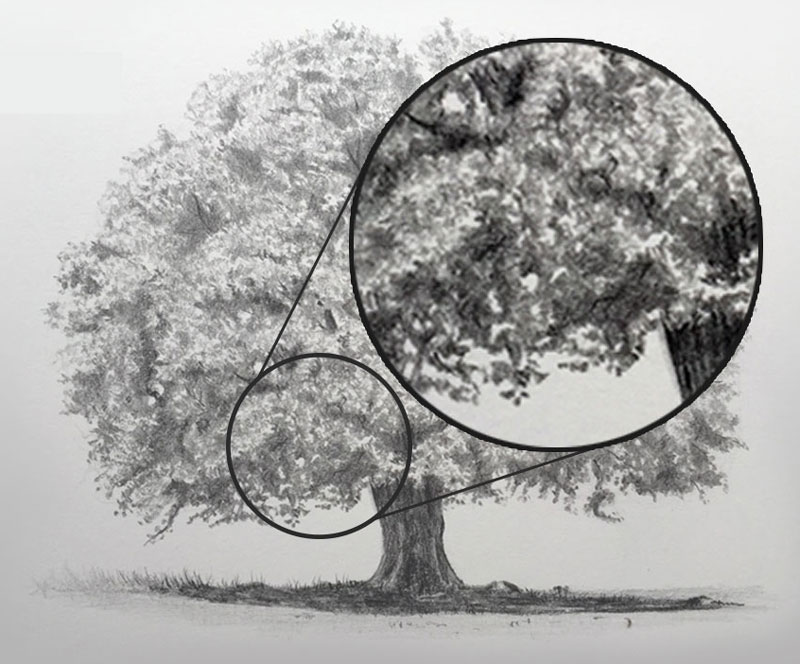
Organic collections of lines can be used to create the illusion of the texture. These lines may be modest squiggles that overlap. Be sure to exit an organic and irregular edge around the outer contours of the tree and exit small open up spaces within the canopy.
Step three - Develop the Value - The illusion of texture is created not only by the marks that are made, simply likewise through the development of the values. Value is the darkness or lightness of a color. Information technology is responsible for communicating non only the calorie-free within the scene, but besides the form and texture of the object. Our goal is to create a full range of value, including the darkest "darks" and the lightest "lights".
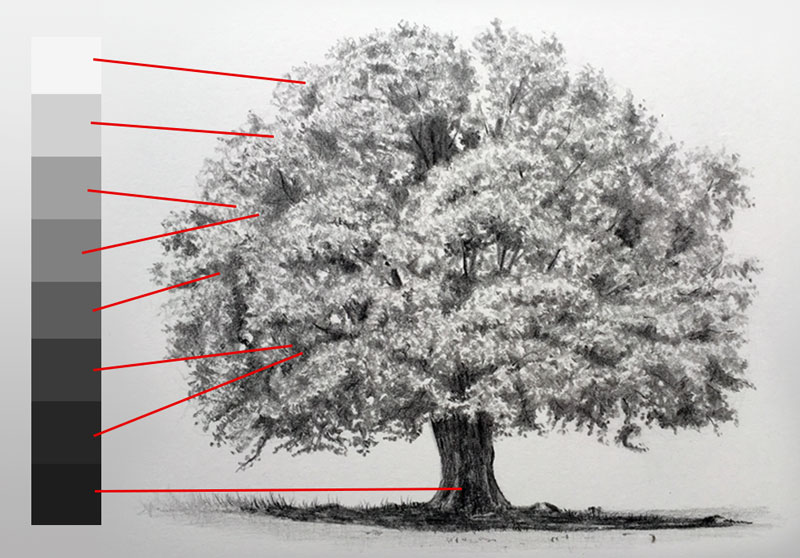
Additional Considerations
1. Accept Your Fourth dimension - As mentioned before, drawing a realistic tree requires patience and persistence. (This is really true for whatsoever subject that yous depict.) Far likewise many people believe that cartoon should be quick and easy. Sometimes just "slowing downwards" and patiently developing the cartoon leads to considerable improvement.
two. You Are Creating an Illusion - Cartoon is an act of illusion. It is the development of the shapes, textures, and value that create this illusion. There's no need to describe everything that you run into. Instead, concentrate on how you tin create the illusion of what you see.
3. Deviations are Acceptable - When drawing from observation, deviations from the original reference or field of study are inevitable. Creating an verbal copy of your discipline probably shouldn't be your goal. Don't put unnecessary pressure level on yourself to be "perfect". This will just lead to frustration.
Lesson Two: How to Draw a Tree with Pen and Ink
Basic Elements to Consider When Cartoon a Tree
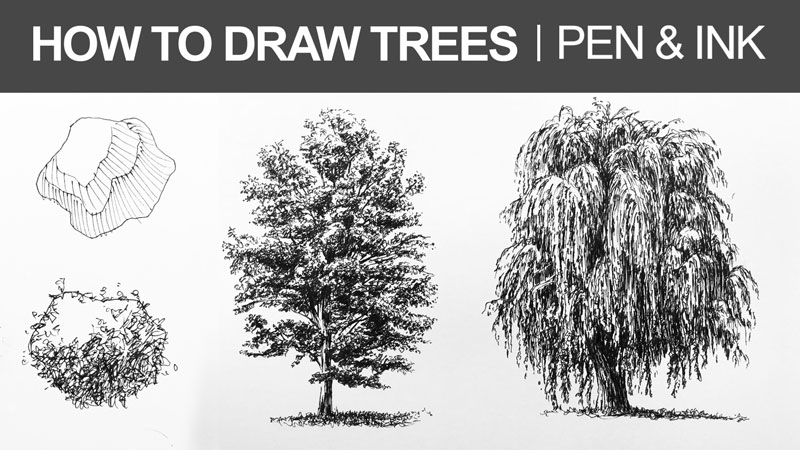
When nosotros create a drawing of a tree with pen and ink, nosotros'll consider the aforementioned basic elements. Remember, the details that nosotros see - the leaves, branches, and trunk tin can all be simplified, making the illusion that we create in a drawing a bit more manageable. When we draw, we create an illusion - non always an exact copy of what we see.
Just similar with graphite drawing, creating this illusion in a pen and ink cartoon can be accomplished by focusing on iii key elements:
- Shape
- Class
- Texture
The post-obit video demonstrates how to draw a tree with pen and ink by focusing on these iii bones elements.
Recognizing the Shape of the Tree
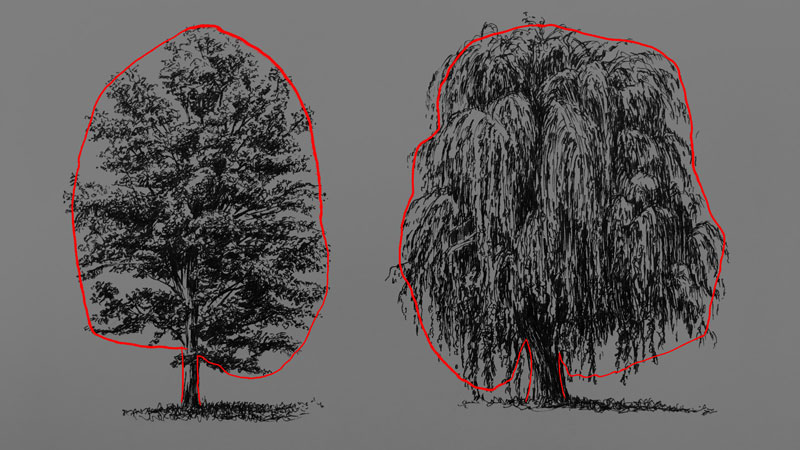
Trees are clearly organic subjects and the shapes that they create are besides organic. The outset thing that we demand to recognize is the overall shape of the tree which will vary based on the blazon of tree that y'all are drawing.
To recognize the shape of the tree, look at the overall contour of the shape. If yous struggle with seeing this, endeavour squinting your eyes - blurring out the details. Expect at the outer edges of the tree and simplify what you lot are seeing into a line that can be enclosed.
This overall shape can be loosely sketched with a graphite pencil. Use a light touch so that the graphite can be erased easily one time ink applications take been made. Brand comparisons between your drawing and what you are seeing and make any necessary changes.
Finding the Shapes Within the Tree
With the basic contour in place, we can begin to locate smaller shapes that happen within the body of the tree. Copse are made up of collections of leaves and branches that extend from the trunk. These collections of leaves and branches are forms only before nosotros develop the illusion of these forms, nosotros must recognize the bones shapes that they create.
Again, these bones shapes tin be lightly sketched with a graphite pencil. We aren't concerned with the details of the leaves at this point. Instead, we just want to simplify the collections of leaves into basic shapes. The shapes that you lot depict will over again vary based on the type of tree that you are drawing.
If you notice that recognizing these basic shapes is hard, endeavor looking for areas of contrasting values. Typically, darker values are found on the lower portion of each shape with lighter values on the acme.
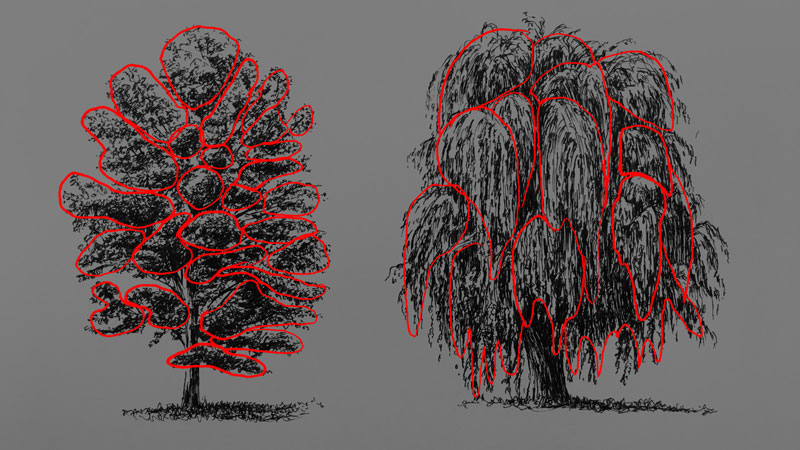
Creating the Illusion of Form
Now, we need to create the illusion of form. In order to create this illusion, we'll need to consider the light source and add darker values in locations of shadow while leaving areas of lighter value in locations of highlight. The key to creating the illusion of form with whatever bailiwick lies in the locations of value.
For each of the smaller shapes that nosotros drew in the last step, nosotros'll add together darker values in the locations of shadow. These areas of shadow exist mainly on the contrary side from where the light source originates. And like with basic forms, there will be a gradation of value from light to dark, creating locations of midtone. Since these forms are irregular, the locations of shadow and eye values are also irregular.
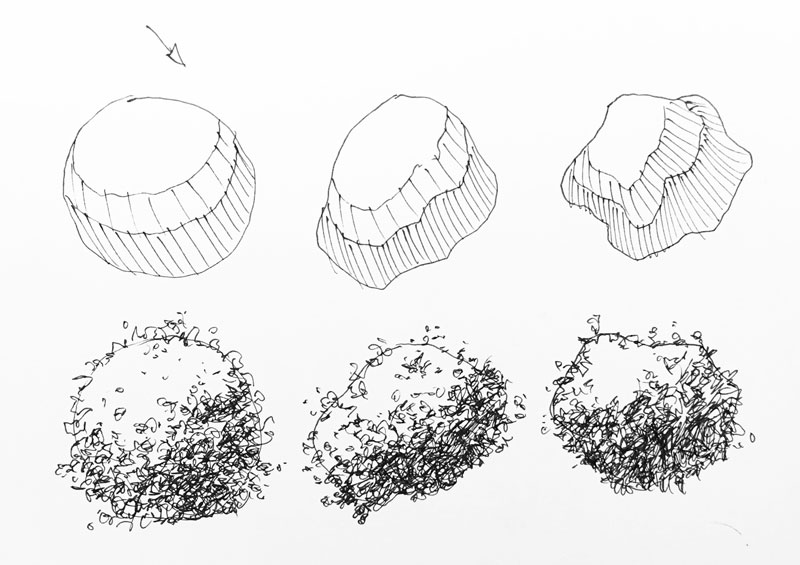
These values are added and developed through textural marks that resemble the texture of the leaves. Textural marks are more than concentrated in locations where the value is darker and more thin in areas where the value is lighter.
Adding Texture to The Tree with Pen and Ink
When drawing with pen and ink, the values that are created are by and large dependent on optical mixing. Since every marker is night, even when applied with lite force per unit area, we must rely on the white of the paper to affect the perceived value. This is important to remember since we are building up the value equally we develop the texture.
It'due south easy to become focused on each individual foliage when drawing a tree. But in our drawing, we don't demand to depict every single one. Instead, we demand to mimic the texture that is perceived. Surprisingly, this can exist achieved with very loose marks with pen and ink.
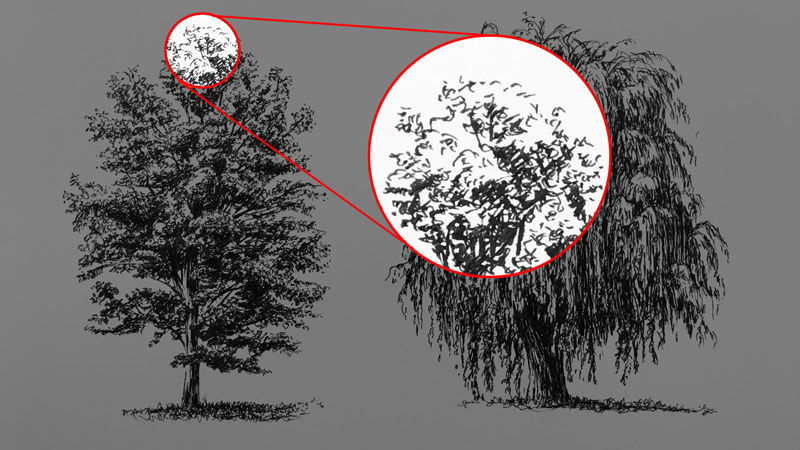
With many species of trees, modest squiggly lines made with the pen tin can create a convincing texture.
No matter what type of blueprint y'all make up one's mind to use for developing the texture, it'south of import to stay consistent. Make sure that the marks that yous add together to the superlative of the tree are consistent with the marks that are used to describe the middle and bottom of the tree.
Fifty-fifty though loose, squiggly marks result in a believable texture, information technology doesn't hateful that this process is fast. Take your fourth dimension and patiently develop each section. Accept breaks if necessary. Working slowly will pay off in the end.
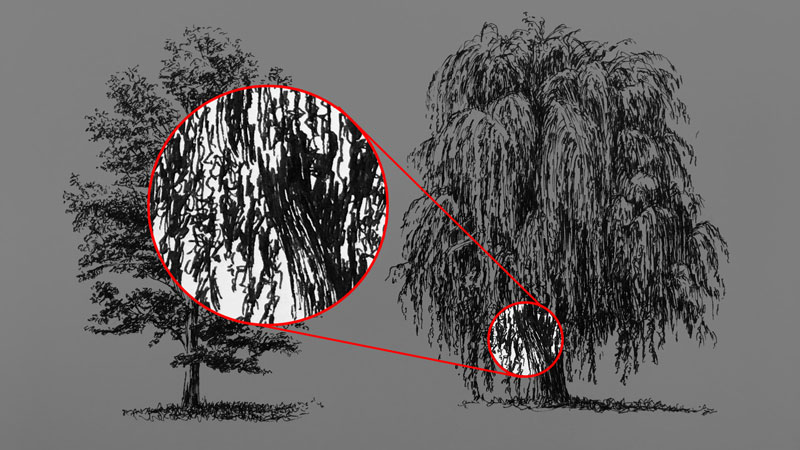
Directional strokes can be used to develop the texture of the trunk of the tree. Over again, we tin concentrate these marks in areas of shadow and permit them to become more sparse in areas where light is striking.
Even a subtle change in the textural marks that you brand will produce enough contrast to communicate a different texture in the drawing.
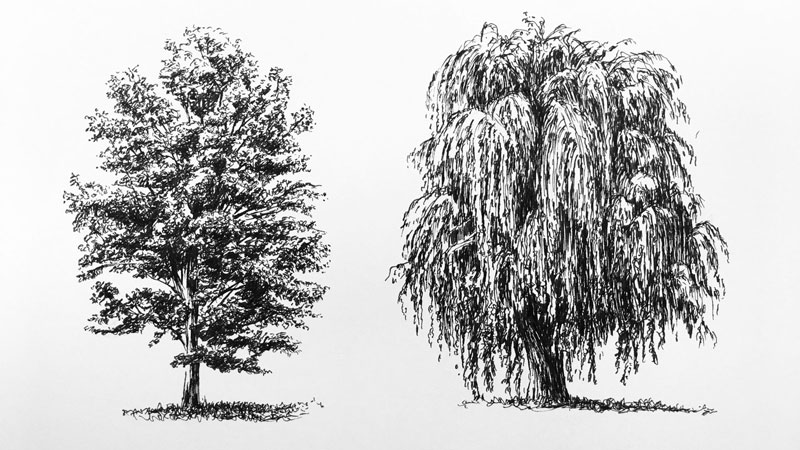
Once all of the ink applications have been made and allowed to dry completely, a kneaded eraser can be used to remove any of the graphite guidelines that may be visible.
Lesson Three: How to Depict an Old Tree with Charcoal
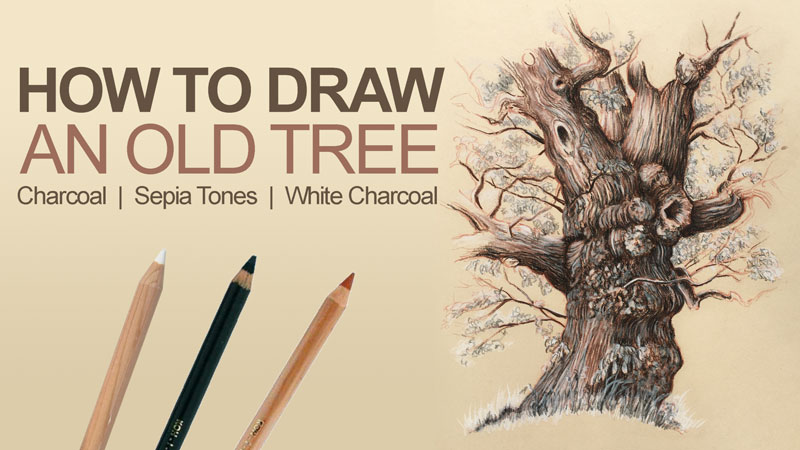
Capturing The Graphic symbol of a Sometime Tree in a Drawing
Every living thing has its own personality and trees are no different. As artists, part of our duty is to capture the personality of the subject - the grapheme of the entity - in our drawings. This can exist a daunting task if nosotros allow ourselves to go overwhelmed with details or go also obsessed with realism. But if we look for $.25 of visual data that can be exploited in the form of a drawing, then we're probable to capture the character, resulting in a cartoon that is authentic while still telling a visual story.
When it comes to trees, the graphic symbol is oftentimes found in the shapes, lines, values, and textures - the same things that we would look for if our goal was to create a photo-realistic drawing.
The following video demonstrates the procedure of drawing an old tree with charcoal and sepia tones.
Cartoon with Charcoal and Sepia Tones
Charcoal, a black powdery medium from burnt organic textile, and the reddish-chocolate-brown tones of the colour, sepia are a match "fabricated in heaven". The earthy tones of any sepia fabric, whether it exist pastel or conte, marry well with the rich darks produced by charcoal. And when you lot add a piddling white charcoal into the mix, a beautiful range of value and color tin can be achieved.
What is Sepia?
Simply put, sepia is a range of color from browns to reds. All sepia tones have a chip of earthy red and brown in them in varying degrees. Originally, sepia ink was widely-used as a writing ink in early Greek and Roman civilizations and was also used by artists - perhaps nearly famously, by Leonardo da Vinci.
Sepia tones are used in every artistic medium from photography to painting. They can be used as colour enhancements in photos to make them appear older or as underpaintings. The softer tones produced by sepia colors add together a touch of color to an otherwise monochromatic composition.
Sepia tones are often used alongside charcoal to soften the strong blacks produced the material. The ruby-red-browns besides add a bit of color to the drawing, calculation interest. Sepia tones are well-nigh effective when used for subjects that already accept reds and brown in them naturally, such as portraits and landscapes.
How to Draw an Old Tree Step by Step
In this lesson, we're working on toned Stonehenge paper (Fawn, Vellum surface). Stonehenge papers are 100% cotton which results in a soft surface. Softer surfaces naturally produce a softer marking which may be preferred by some artists.
We'll brainstorm by lightly drawing the contours of the tree with a Reddish Chalk pencil from the Gioconda pencil line from Koh-i-noor. Although this pencil is labeled equally a "chalk" pencil, information technology feels and behaves like an oil pencil.
The marks at this stage are light and loose every bit we try to find the boundaries of the subject. The most important element at this stage is the cadre of the trunk and the branches of the tree. We'll also exaggerate the contours a bit, making them bumpier. This will add some character to the tree and brand it announced a bit older.
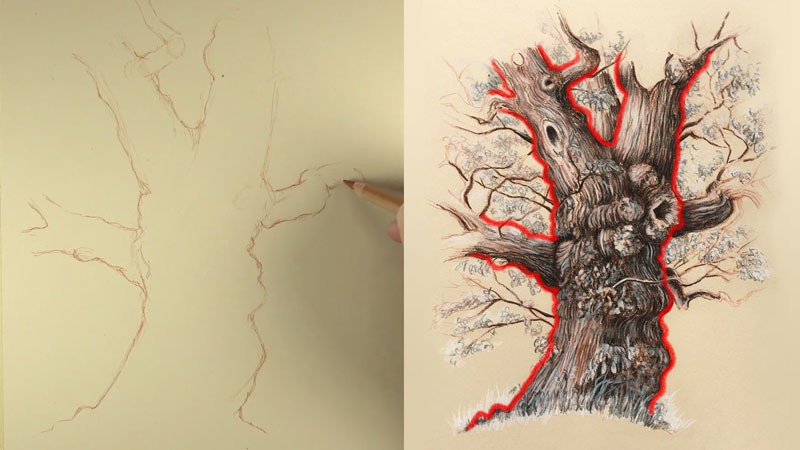
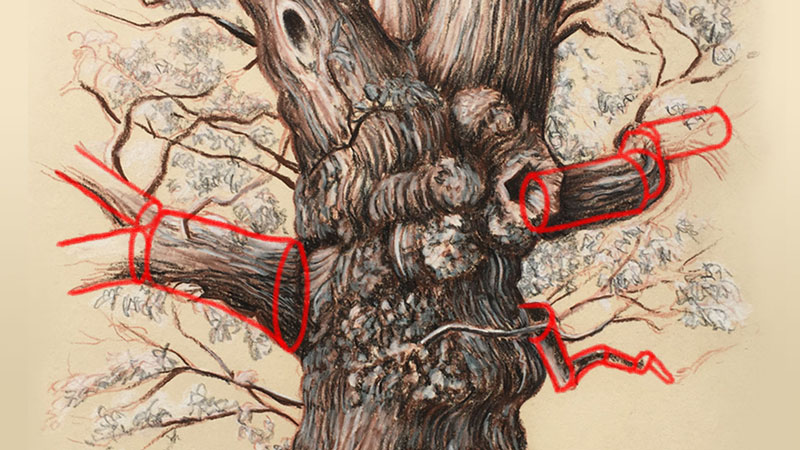
It may be helpful to think of the branches as tubes or cylinders. Information technology'southward like shooting fish in a barrel to add branches that extend from the edges of the torso, but some of these should bend and turn towards and abroad from the viewer. Cartoon the branches in this way adds depth.
Once the contours are loosely sketched, we can enhance the line quality. Line quality refers to the thickness or thinness of the line. There should be some variety hither. More often than not, portions of the tree that are thicker can be defined by a thicker line. This means that we tin can revisit the core of the trunk and brand the lines that define it a niggling thicker.
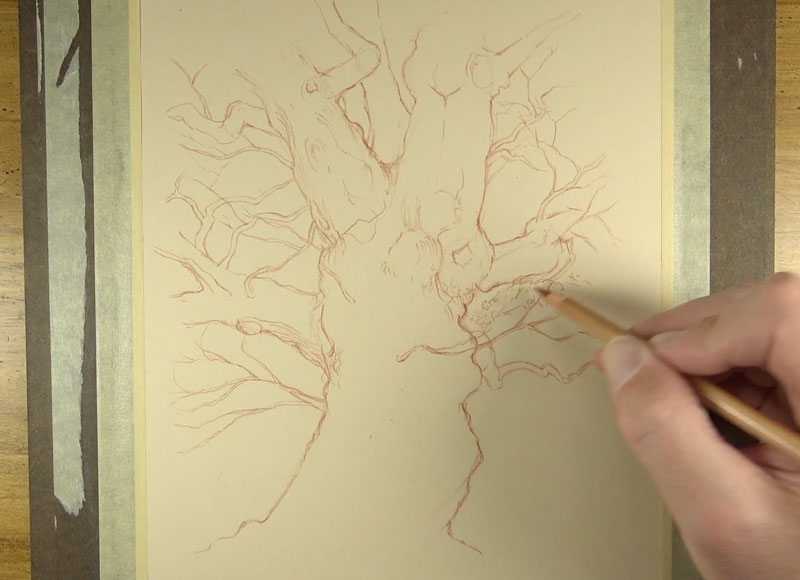
Now that the contours are in identify, we can get-go to develop the texture on the body of the tree. Mostly, this texture is divers by line applications. The directional lines that we add here are important and should flow with the form of each department of the tree. Lines that menstruum over the form of the bailiwick are referred to as "cross contour lines". Information technology's important to indicate out that the texture of the tree changes throughout. In some areas the lines are predominantly directly, while in other locations the lines may be made upwardly of smaller circles.
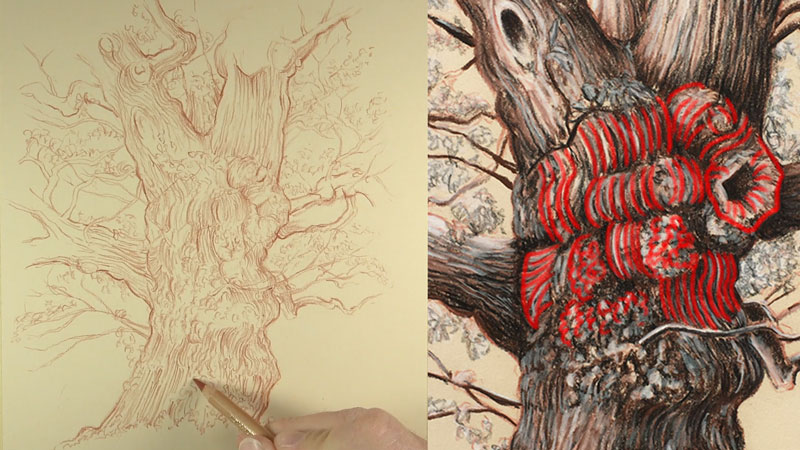
At present we're ready to brainstorm addressing the value range. Value is the darkness or lightness of a color. Value communicates the form and texture of the subject area. We'll start by applying an application of white charcoal over the majority of the tree. By doing this, nosotros can preserve the lighter areas before developing the darker ones. The stroke of the mark should exist considered here too. Just like in the terminal pace, nosotros'll make marks that flow with the cross contours.
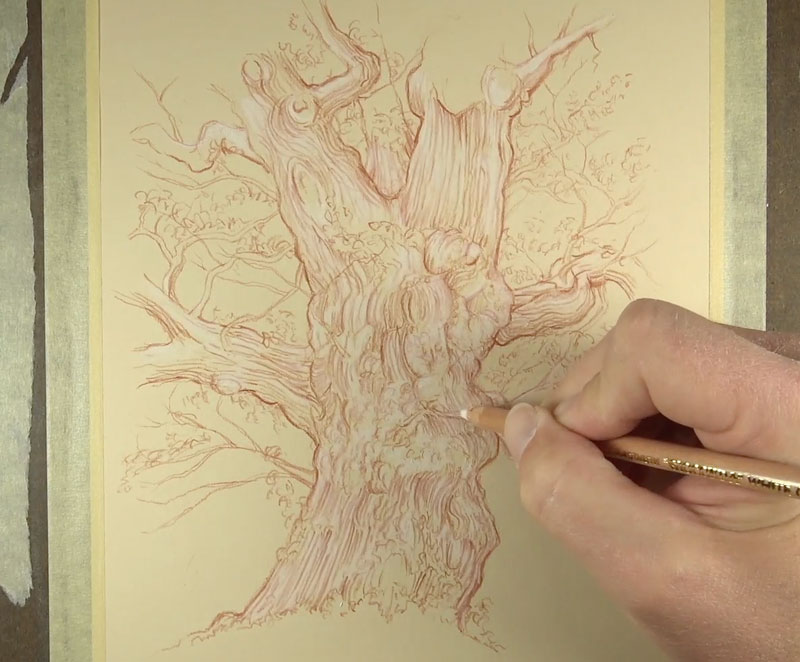
We'll begin introducing darker tones and midtones with a Sepia Light pencil from the Gioconda line. This pencil is powdery and behaves in a similar manner as a pastel pencil. Since the lite source originates from the upper left, darker tones are concentrated on the correct side of the tree. Notwithstanding, since the tree is curved, some darker tones are likewise found on the left side. Once more, strokes applied with the pencil flow with the cross contours.
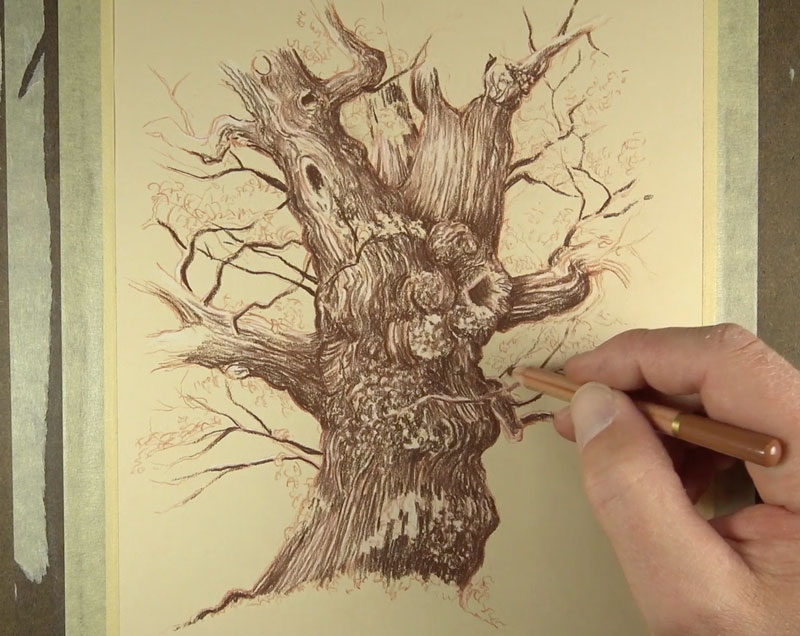
Before going even darker, the white charcoal pencil can be used to soften areas where the contrast may be as well enervating.
Now we can push button the darker tones with a charcoal pencil. We shouldn't embrace the applications made with the Sepia Light pencil completely, merely instead focus on the locations where the value should exist very dark. Again theses locations exist on either side of the tree, but are more than dominant on the side reverse from the low-cal source.
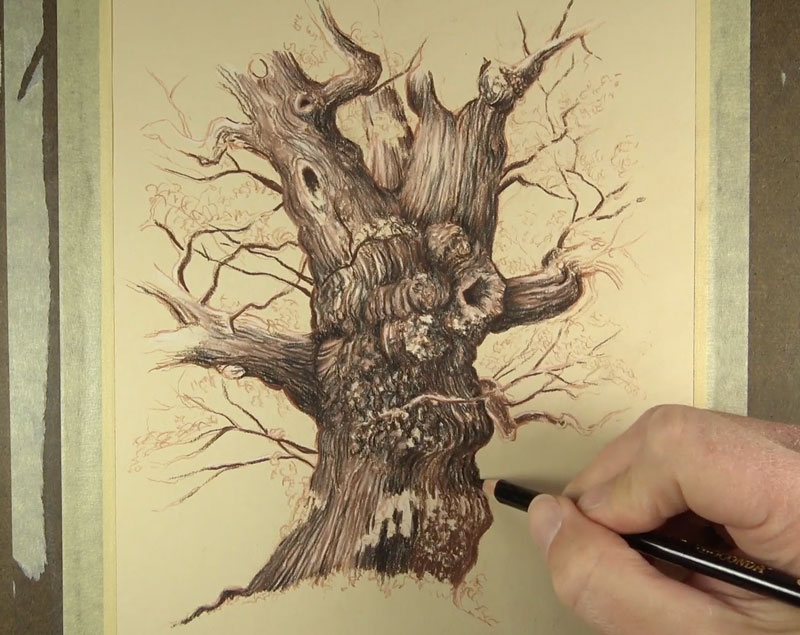
We can at present go back with a sharpened white charcoal pencil and enhance the highlights further. This broadens the range of value and increases the contrast. Edges are then refined and blacks deepened using a Negro pencil.
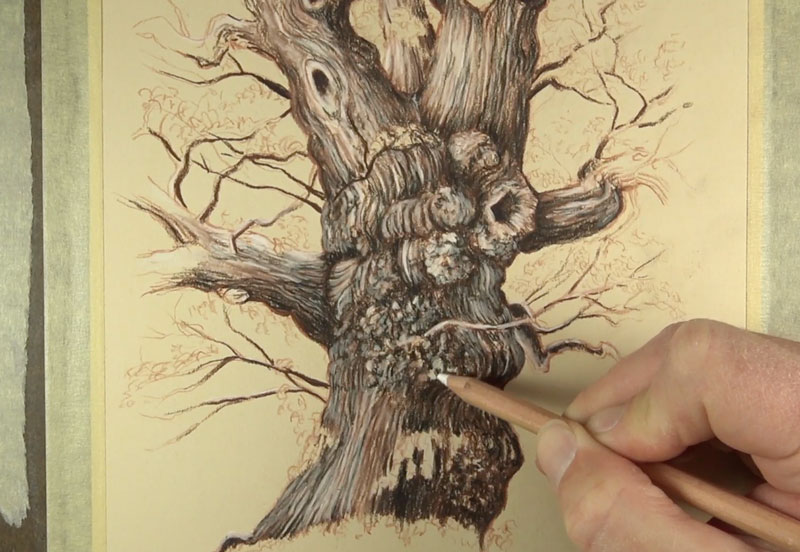
We can then fill in loose indications of leaves and grass at the bottom of the tree and throughout the canopy using a combination of the white charcoal pencil and Negro pencil to complete the image.
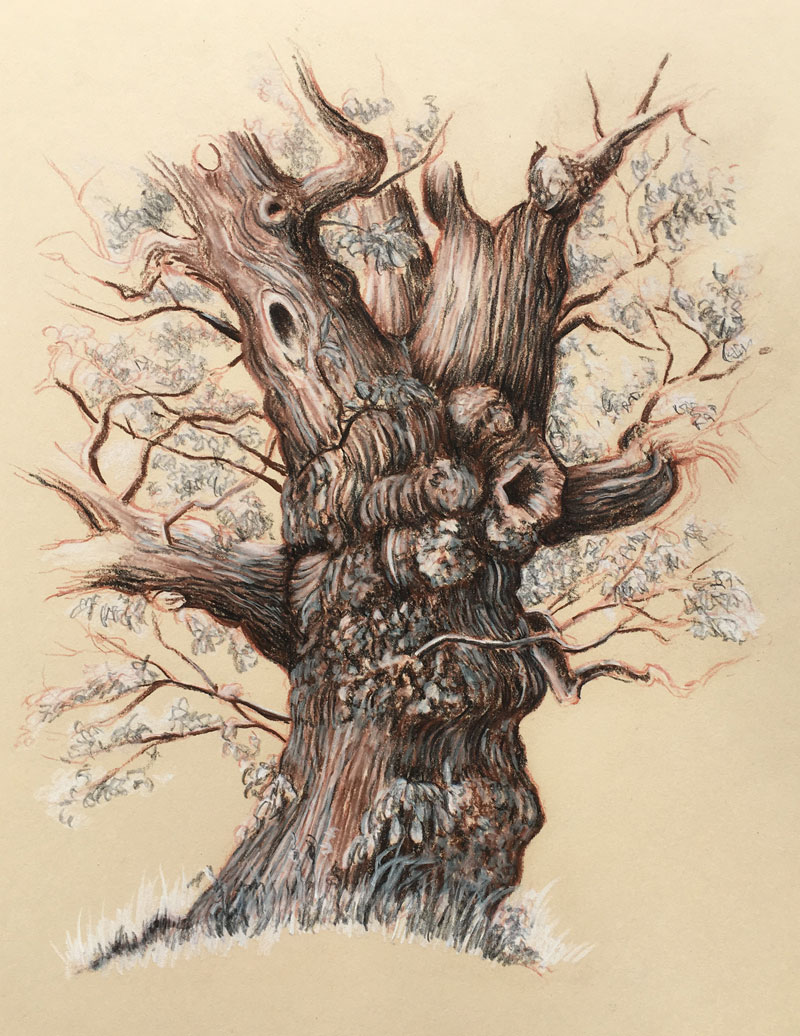
While the combination of charcoal and sepia tones can be used for whatsoever discipline, they work best when applied to those that naturally contain ruby-red earth tones like our tree. The process is quick without sacrificing much control. And when information technology comes to drawing copse and capturing their character, focus on the basic shapes, lines, and textures - exaggerating them when possible.
Lesson Iv: Drawing Trees with Colored Pencils
Drawing is all about creating an illusion. We see the earth around usa as lines, shapes, forms, textures, and colors. This is how our eyes see things anyhow. It is our minds that make sense of these things. Our heed tells united states of america what we are seeing, non our eyes.
As artists, we are in the business of creating illusions. We rely on the manner in which our optics work in gild to "fox" the minds of those that view our fine art.
Issues typically arise when we allow our minds to arrive the way of what our eyes are really seeing.
Although, we are discussing how to draw a realistic tree in this tutorial, this concept of drawing applies to any subject that you may want to tackle.
The Importance of Texture
When it comes to drawing trees, texture will play a crucial role. Nosotros volition need to mimic the observed texture of the leaves of the tree, without drawing every unmarried leaf. So, our goal is to create - you guessed it - an illusion.
This illusion is created past relationships of value. The positioning of the night and light tones will not merely give form to our tree, simply also create the illusion of groupings of leaves. It is the contrast between the darks and the lights that will translate as individual leaves to our viewers.

Nighttime values will exist in shadowed areas, while light values will exist in areas that are receiving light.

The Colors
Since nosotros are building upwards the illusion with colored pencils, we volition need to consider the value of the colors that are used. The leaves on the tree in this demonstration are green. We'll mix areas on the tree to create lighter and darker values using yellow, blue, dark-brown, black, and white. Not simply volition this push the value range, simply it will as well expand the depth in the color.
The blueish that is used is darker in value, so it is used to develop the adumbral areas of the tree.

Yellow is naturally a lighter value as a pure hue, so information technology is used in the areas that are receiving calorie-free. Darker values are enhanced using brown and black, while lighter values are enhanced using white.

The Marks
The marks that are made are besides of import. Marks can be made to mimic the texture of the leaves using modest irregular circles. Drawing each individual leaf would be counter-productive and is unnecessary. Remember, we are creating an illusion based on how how our minds perceive the world effectually us. These pocket-sized marks volition suffice to create this illusion.
We will also demand to consider spaces that be in the canopy of the tree. The tendency is to overlook these openings, but including them is incredibly important.

Of course, these open spaces provide more opportunities for drawing the branches that are visible, which add together to the overall illusion that nosotros are after.
Other Tips
Like with well-nigh colored pencil drawings, layering and building up colors is peculiarly important. Nearly of the time, one awarding of color will non exist plenty to create the required depth in color to create a realistic advent. Fortunately, colored pencils are piece of cake to layer and blend nicely.
Start light when layering colors. Information technology is much easier to build upward colors when initial layers are applied with a calorie-free hand early in the drawing. Layering lightly in the early stages prevents build up of the binder which could hinder heavier applications practical afterward in the drawing process.
Be patient. Colored pencils are a medium that requires patience. It is a time consuming process to layer the pencils properly to create the required illusion. Too often, beginner artists expect firsthand results, when fourth dimension should be devoted to developing a colored pencil drawing.

Source: https://thevirtualinstructor.com/how-to-draw-trees.html
Posted by: levinenes1943.blogspot.com
0 Response to "How To Draw Trees With Colored Pencils"
Post a Comment